Share this article



Not all managed offices deliver the same value. Explore what separates high-performing workspaces from the rest: human-centered design, seamless operations, and built-in agility that turn an office into a true enabler of business performance.
The appeal of a managed office lies in its ability to provide a ready-to-use, customized workspace without the capital investment, long-term lease commitments, and operational complexity associated with traditional office models. As more organizations adopt managed offices to support growth and workforce flexibility, a key distinction has emerged: not all managed offices deliver the same value.
A managed office succeeds when it removes friction from the workplace experience, allowing organizations to focus on their people and business priorities rather than the mechanics of running a space.Beyond the baseline real estate metrics, high-performing managed environments consistently deliver on:
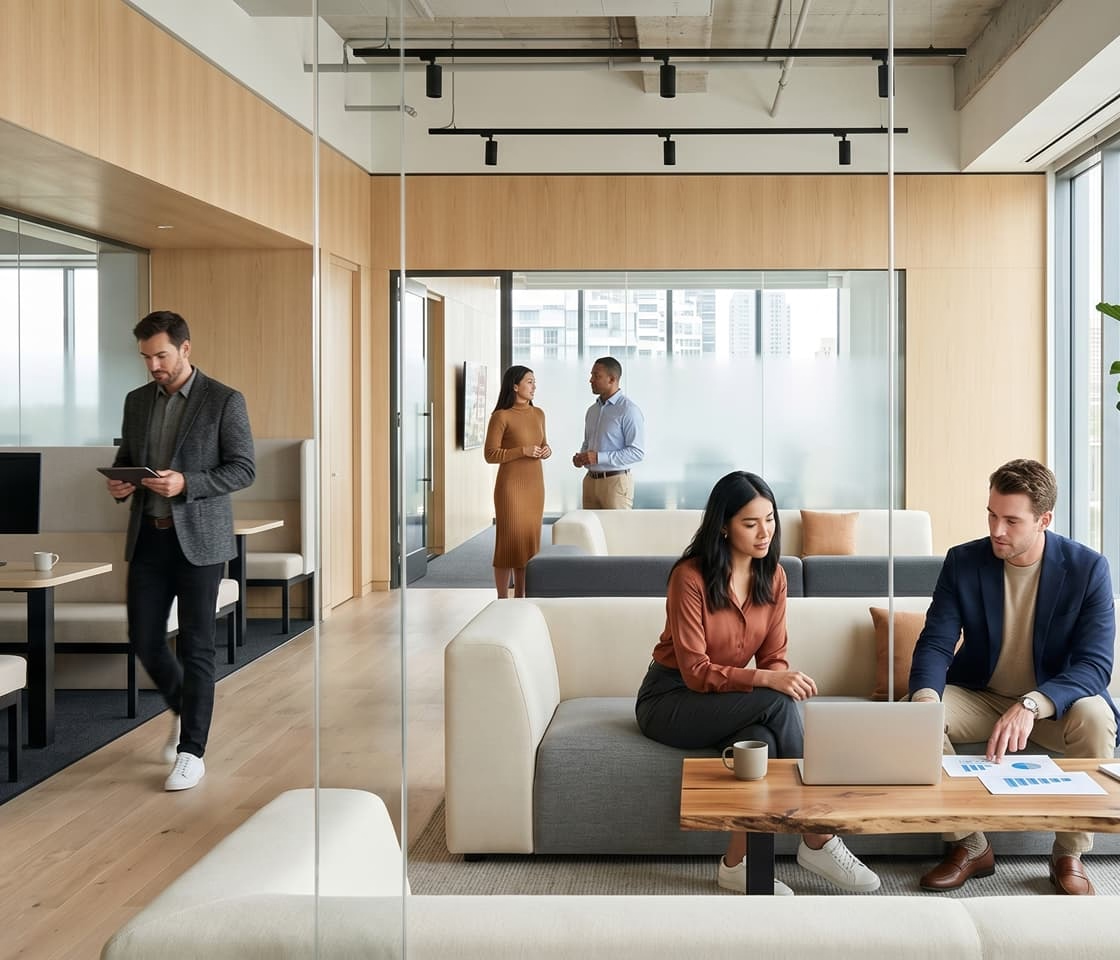
Effective workplaces are designed around how people work. High-performing managed offices balance spaces for focused work, collaboration, meetings, and informal interactions. They recognize that employees move between different modes of work throughout the day and require environments that support those transitions naturally. The result is a workplace that encourages productivity, engagement, and connection.
The best-managed offices are often the ones employees notice the least. Technology functions reliably, maintenance issues are addressed before they become disruptions, and safety and compliance requirements are handled consistently in the background. Rather than reacting to problems, successful operators take a proactive approach that ensures the workplace remains dependable and efficient.
Business needs are rarely linear. Teams expand, project requirements evolve, and workplace strategies shift over time. A managed office works best when it can adapt without major disruption. Flexible layouts, scalable infrastructure, and responsive operational support allow organizations to reconfigure spaces and accommodate changing needs while maintaining continuity for the workforce.
Beyond these factors, the most effective managed offices benefit from alignment across the entire workplace lifecycle. When workplace design, construction, technology, and day-to-day operations are considered as part of a continuous process rather than separate functions, organizations experience fewer handoff issues, greater consistency, and smoother execution.
Technology and workplace data further support this approach by providing insights into how spaces are actually used. When applied, these insights help organizations optimize layouts, improve employee experiences, and make better real-estate decisions over time.
Ultimately, what makes a managed office truly work is not the furniture, finishes, or location alone. It is the ability to create a workplace that is reliable, adaptable, and aligned with the needs of the people who use it. When operational complexity is removed and the workplace evolves alongside the organization, the office becomes more than a physical space, it becomes an enabler of business performance.