

Share this article


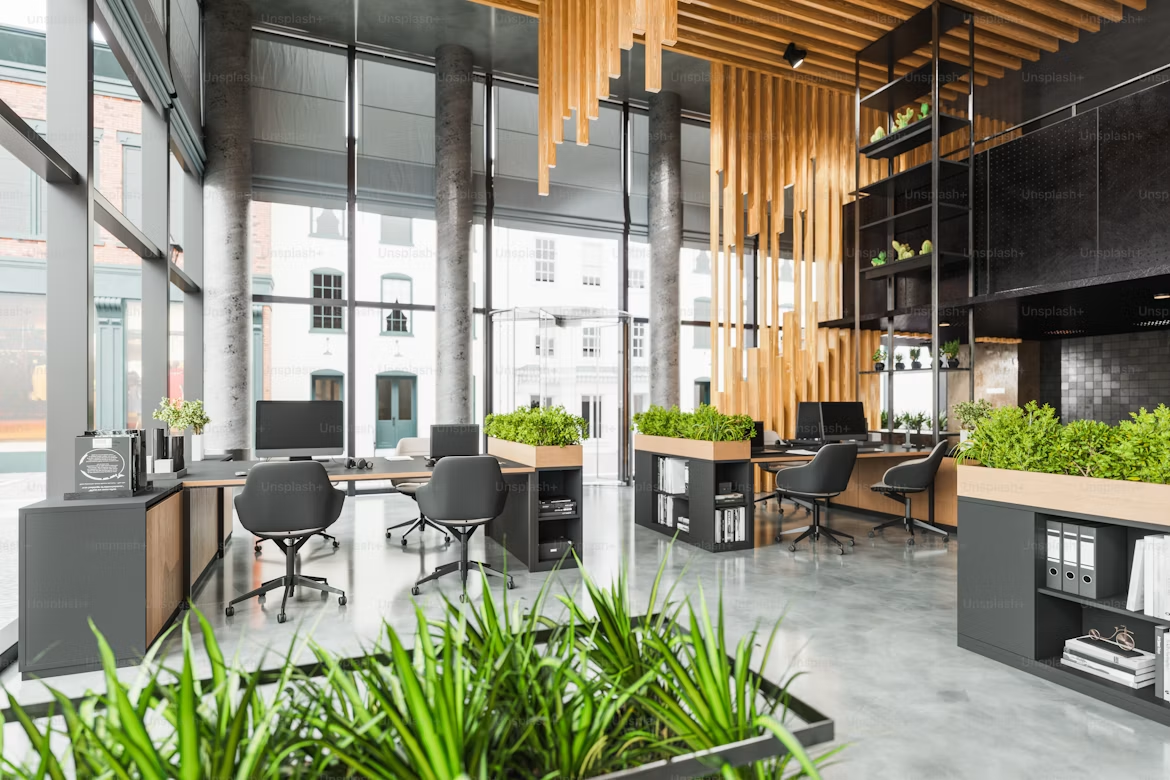
Design intent degrades through hand-offs in traditional delivery. Integrated frameworks maintain continuity from concept to commissioning, ensuring workplaces perform as designed.
Design is often reduced to a discussion of finishes, furniture, and visual appeal. In reality, a high-performing workplace functions as a coherent system: an intentional alignment of spatial adjacencies, circulation patterns, acoustics, lighting, and building services, all calibrated to support specific human behaviors. When this logic holds, spaces feel intuitive and productive. When it breaks, friction becomes embedded in everyday work.
The greatest threat to this system is not poor design, but design dilution. Traditional delivery models move projects through a series of hand-offs, from strategy to design, design to engineering, and engineering to construction. At each transition, the original intent becomes increasingly vulnerable.
Minor adjustments made to resolve local constraints can quietly undermine overall performance. A wall shifted slightly to accommodate a standard duct may compromise acoustic zoning, disrupt sightlines, or turn a focused work area into a circulation spillover. These changes are rarely careless; they are simply disconnected from the purpose the space was designed to serve.
This is why true expertise lies in recognizing that drawings are not the product. Performance is.
Protecting intent requires continuity rather than translation. An integrated delivery framework maintains a continuous digital and decision-making thread from concept through commissioning, supported by advanced Building Information Modelling and single-point accountability. By virtually constructing the workspace before physical execution begins, conflicts between structure, services, and space are resolved before they spiral to the point where change becomes costly and disruptive.
Integration safeguards integrity by coordinating building services within the structural framework from the earliest stages. It enables passive performance by aligning layouts with daylight access, thermal behaviour, and environmental conditions, reducing unnecessary reliance on energy-intensive mechanical systems. Just as critically, it preserves circulation logic by protecting the natural desire lines that shape how people move, interact, and collaborate, elements that are difficult to retrofit once compromised.
When design intent is protected through delivery, the workplace performs as a unified whole rather than a collection of optimized parts. Spatial logic, environmental performance, and human experience reinforce one another instead of competing for priority.
Integrated design is not an indulgence or a premium add-on. It is a strategic safeguard against underperforming assets and post-occupancy correction. When the distance between the person who defines the intent and the team that executes it disappears, the finished workplace delivers on its original promise: functionally, experientially, and operationally.