
Share this article


Site logistics and EHS are foundational disciplines that enable efficient, safe project delivery. Covers access and circulation, material staging, temporary facilities, hoisting, neighbor relations, safety management systems, common construction risks, regulatory compliance in India, and building safety culture.
Site logistics and environmental health and safety (EHS) are often treated as secondary concerns in construction management, addressed after the "real" work of design and procurement is complete. This is a mistake. Poor site logistics create inefficiency, delay, and cost overruns. Inadequate EHS programs create injuries, regulatory problems, and project shutdowns.
Projects that excel at logistics and EHS do not treat them as compliance exercises. They treat them as operational disciplines that enable everything else to work. Good logistics means materials arrive when needed, workers have space to work productively, and site operations do not create conflicts with neighbors or authorities. Good EHS means workers go home safely, regulatory requirements are met, and incidents do not derail project progress.
This article explains how to approach site logistics and EHS in Indian commercial construction to enable efficient, safe project delivery.
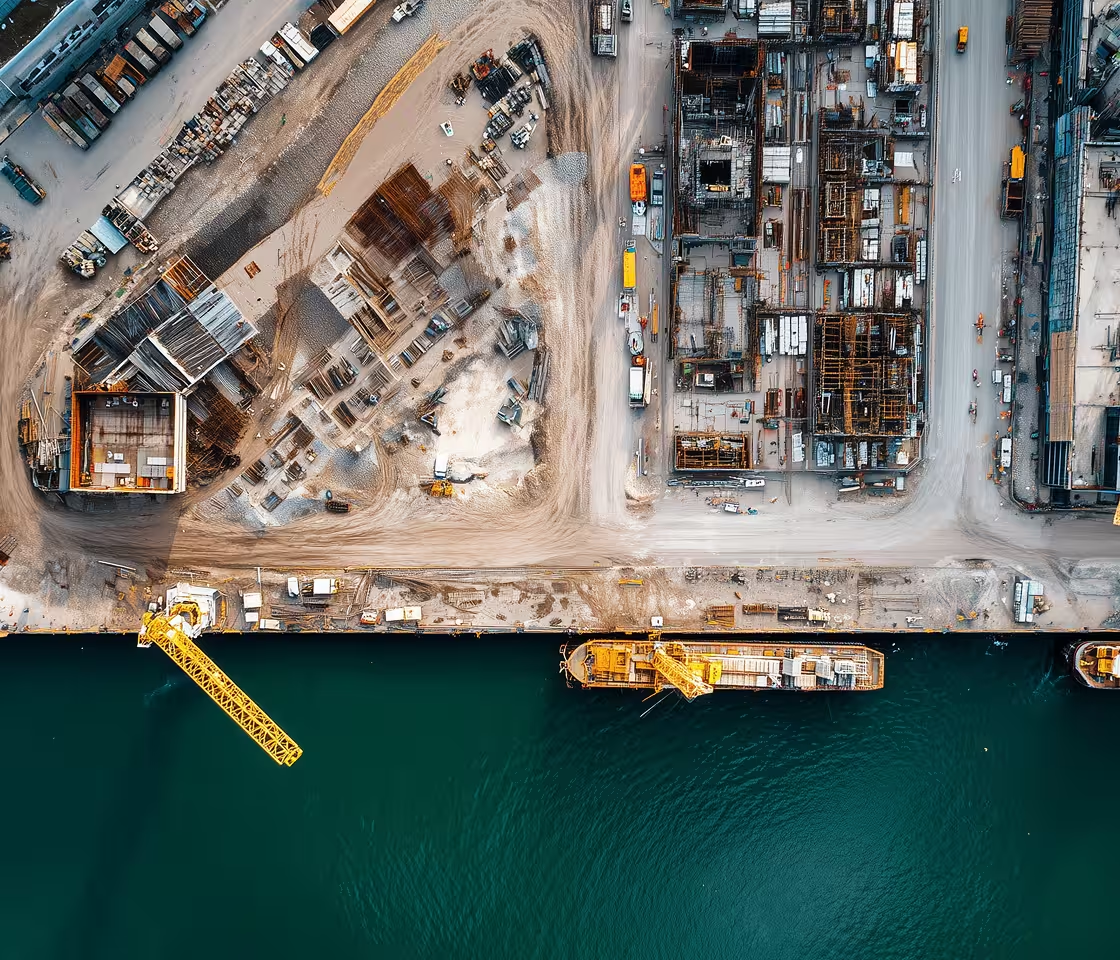
Site logistics is the discipline of managing the physical aspects of construction site operations: how materials arrive and are stored, how workers access the site and move within it, how equipment is positioned and operated, and how site activities interact with the surrounding environment.
Site access planning addresses how people, materials, and equipment enter and move through the site. Key considerations include:
In urban commercial projects, access is often constrained. Sites may have limited entry points, shared access with other tenants or buildings, and restrictions on timing or vehicle size. Access planning must account for these constraints rather than assuming unlimited flexibility.
Construction materials must be staged and stored on site until installation. Planning considerations include:
In constrained urban sites, storage space is limited. Material deliveries must be coordinated closely with installation to minimize staging requirements. Prefabrication off-site can reduce on-site storage needs.
Construction requires temporary facilities for workers and operations:
Temporary facilities should be planned early and positioned to support efficient operations without conflicting with construction activities.
Multi-story construction requires vertical transportation of materials, equipment, and workers. Options include:
Hoisting strategy affects site layout, schedule, and cost. Crane positioning, hoist locations, and sequencing should be planned during preconstruction, not improvised during construction.
Construction creates noise, dust, vibration, and disruption that affect neighbors and building occupants. Management strategies include:
In occupied buildings or dense urban areas, neighbor relations can significantly affect project execution. Proactive communication and responsive management reduce conflicts and complaints.
Construction traffic affects both site operations and surrounding areas:
In urban areas, traffic management may require permits, police coordination, and compliance with local regulations.
Effective logistics planning follows a structured process:
Site assessment. Understand site constraints: access points, adjacent properties, utilities, ground conditions, and any restrictions from landlords, authorities, or neighbors.
Construction sequence analysis. Understand the construction sequence to identify when materials and equipment are needed, what staging is required, and how site layout must evolve through the project.
Logistics plan development. Develop a logistics plan that addresses access, storage, facilities, hoisting, and neighbor management. The plan should include site layout drawings for key phases showing how the site will be organized.
Coordination with stakeholders. Review the logistics plan with contractors, landlords, neighbors, and authorities. Identify conflicts and constraints early.
Implementation and monitoring. Implement the logistics plan and monitor compliance. Adjust as conditions change or problems emerge.
Logistics planning should begin during preconstruction and continue through project completion. A plan developed once and never updated will not reflect evolving site conditions.
EHS in construction encompasses worker safety, environmental protection, and regulatory compliance. Good EHS performance is a moral obligation, a legal requirement, and a practical necessity for project success.
A safety management system provides the framework for preventing injuries and managing safety risks. Key elements include:
Safety planning. Before work begins, identify hazards, assess risks, and plan controls. Safety planning should occur at project level (overall safety plan) and activity level (task-specific risk assessments and method statements).
Hazard identification and risk assessment. Systematically identify hazards associated with construction activities and assess risks based on likelihood and severity. Common construction hazards include falls from height, struck-by incidents, electrical hazards, excavation collapse, confined spaces, and equipment operation.
Control measures. Implement controls following the hierarchy: elimination (remove the hazard), substitution (use less hazardous alternatives), engineering controls (physical barriers, ventilation, guarding), administrative controls (procedures, training, supervision), and personal protective equipment (last resort).
Training and competency. Workers must be trained in safe work practices, hazard recognition, and emergency procedures. Specialized work (scaffolding, crane operation, electrical work, confined space entry) requires verified competency.
Supervision and enforcement. Safety rules must be enforced through supervision, monitoring, and consequences for non-compliance. Safety programs without enforcement become paperwork exercises.
Incident management. When incidents occur (including near-misses), investigate root causes, implement corrective actions, and share lessons learned. Incident reporting should be encouraged, not punished.
Monitoring and review. Track safety performance through leading indicators (inspections, training completion, near-miss reports) and lagging indicators (injuries, incidents). Review performance regularly and adjust programs as needed.
Certain hazards cause disproportionate harm in construction:
Falls from height. Falls are a leading cause of construction fatalities. Controls include guardrails, safety nets, personal fall arrest systems, proper scaffold erection, and controlled access to elevated work areas.
Struck-by hazards. Workers are struck by falling objects, moving vehicles, or swinging loads. Controls include hard hats, exclusion zones during lifting, traffic management, and securing materials against falling.
Electrical hazards. Contact with energized electrical systems causes electrocution and burns. Controls include lockout/tagout procedures, safe work clearances, insulated tools, and verified de-energization.
Excavation hazards. Excavation collapse buries workers. Controls include shoring, sloping, benching, and access/egress provisions.
Confined spaces. Entry into spaces with limited access and potential atmospheric hazards (tanks, pits, ducts) requires specific procedures: atmospheric testing, ventilation, standby personnel, and rescue provisions.
Heat stress. In Indian conditions, heat stress is a significant risk. Controls include hydration, rest breaks, shaded areas, and recognition of heat illness symptoms.
Construction in India is subject to various safety and environmental regulations:
Building and Other Construction Workers Act. This central legislation establishes safety and welfare requirements for construction workers, including registration, welfare provisions, and safety standards.
Factories Act. Applicable to manufacturing and certain construction activities, this act establishes safety, health, and welfare requirements.
Environmental regulations. Construction activities may require environmental clearances, pollution control board consents, and compliance with air and water quality standards. Waste disposal, dust control, and noise limits may be regulated.
Local regulations. Municipal and state-level regulations may impose additional requirements related to site safety, traffic, noise, and working hours.
Regulatory compliance requires understanding applicable requirements, implementing compliant programs, maintaining documentation, and managing inspections and approvals.
Logistics and EHS are interconnected. Good logistics planning supports safety; poor logistics creates hazards.
Traffic separation. Logistics planning that separates vehicle and pedestrian traffic reduces struck-by risks.
Material handling. Planned material staging and hoisting reduces manual handling injuries and falling object risks.
Site organization. Well-organized sites with clear circulation, adequate lighting, and maintained housekeeping are safer than cluttered, chaotic sites.
Temporary facilities. Adequate welfare facilities support worker health and alertness, reducing incident risk.
Access planning. Proper access provisions (stairs, ladders, scaffolds) reduce fall risks compared to improvised access.
Logistics and EHS should be planned together, not as separate workstreams.
Compliance-based safety (doing the minimum required by rules) produces limited results. Projects with strong safety performance build a safety culture where safety is valued, expected, and reinforced.
Leadership commitment. Safety culture starts at the top. Project leaders must visibly prioritize safety, allocate resources, and hold themselves and others accountable.
Worker involvement. Workers have frontline knowledge of hazards and practical solutions. Involve workers in safety planning, hazard identification, and problem-solving.
Open communication. Create an environment where safety concerns can be raised without fear of retaliation. Encourage near-miss reporting and safety suggestions.
Recognition and reinforcement. Recognize safe behavior and safety improvements. Reinforce that safety is valued, not just mandated.
Continuous improvement. Treat safety as an ongoing journey, not a destination. Learn from incidents, near-misses, and industry experience. Continuously improve practices.
Building safety culture takes time and consistent effort. It cannot be created through policies alone; it requires sustained leadership attention and organizational commitment.
If you are managing site logistics and EHS for a commercial construction project in India:
Plan logistics early. Develop logistics plans during preconstruction, not after construction starts. Understand site constraints and plan operations accordingly.
Integrate logistics and safety. Plan logistics with safety in mind. Site organization, traffic management, and material handling all affect safety outcomes.
Invest in safety planning. Do not treat safety as paperwork. Invest in meaningful hazard identification, risk assessment, and control planning.
Enforce consistently. Safety rules without enforcement are ineffective. Establish clear expectations and consistent consequences.
Manage contractors. In multi-contractor environments, coordinate safety across all parties. Establish common standards and hold all contractors accountable.
Monitor and adapt. Track logistics and safety performance. Address problems promptly and adjust plans as conditions change.
Build culture. Compliance is necessary but not sufficient. Build a culture where safety is valued and expected by everyone on site.
Site logistics and EHS are not secondary concerns. They are foundational disciplines that enable efficient, safe project delivery. Projects that get them right perform better. Projects that neglect them pay the price in inefficiency, delay, injury, and regulatory problems.
Vestian's construction teams bring disciplined approaches to site logistics and EHS management. We plan logistics as part of preconstruction, not as an afterthought. We implement safety programs that go beyond compliance to build genuine safety culture. And we maintain the oversight and accountability that keeps sites running safely and efficiently.
If you need construction support for a commercial project in India, reach out to start a conversation.